

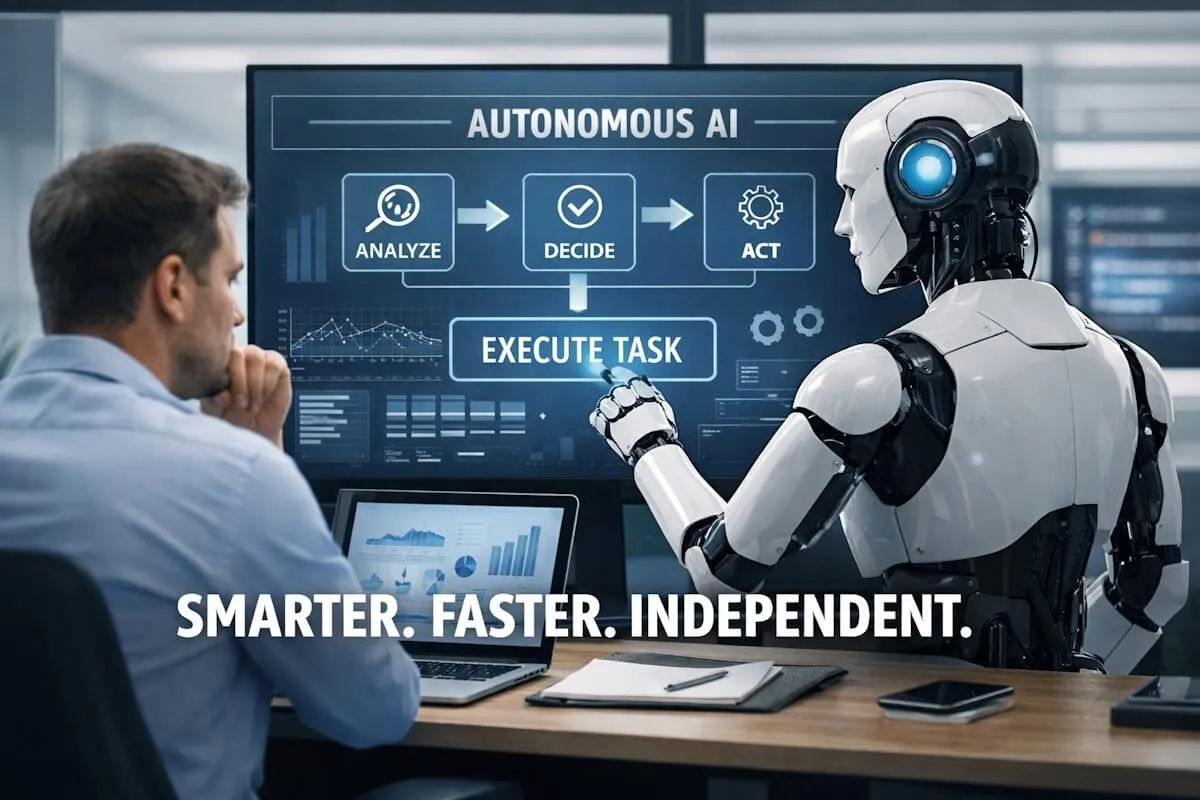
Business is changing, fast. You’ve probably noticed it already. Tools are getting smarter. Systems are starting to “decide” things on their own. And somewhere in the middle of all this, a new shift is quietly taking shape.
It’s not just about automation anymore. It’s about systems that can take action without waiting for constant instructions.
That’s where agentic AI steps in.
If you’re running a business, building a product, or even planning your next move, this is something you can’t ignore. So let’s break it down in a way that actually makes sense.
What is Agentic AI, really?
Let’s keep it simple.
Agentic AI refers to systems that don’t just respond. They act. They make decisions, plan steps, and follow through based on goals you set.
Think about it like this. Instead of telling a system what to do step by step, you give it an outcome. It figures out the rest.
You’re not babysitting it. You’re guiding it.
That’s a big shift.
Earlier systems needed constant inputs. Click here. Approve this. Run that report. Now imagine a setup where those steps just happen in the background.
Sounds like a small upgrade? It’s not. It changes how work gets done at a core level.
Why businesses are paying attention now
You might wonder, why now?
Because businesses are hitting a wall with traditional automation.
Most workflows today are still dependent on human triggers. Even the so-called smart systems need someone to push the button.
Agentic AI removes that dependency.
It allows systems to:
- Monitor situations continuously
- Take action when conditions change
- Learn from past outcomes
- Adjust behavior without waiting for instructions
That means fewer delays, fewer manual tasks, and a lot more speed.
And let’s be honest. Speed matters. A lot.
The shift from tools to teammates
Here’s where it gets interesting.
We’ve always treated software like tools. You use them when needed. You close them when done.
Agentic AI flips that idea.
Now, these systems act more like teammates. They’re always on. They’re always working. They’re handling tasks while you focus on bigger decisions.
Imagine having:
- A system that handles customer queries end-to-end
- A process that manages leads without constant supervision
- A workflow that fixes issues before you even notice them
That’s not some distant idea. It’s already happening.
And businesses that adopt this early? They’re going to move faster than everyone else.
Real impact on day-to-day operations
Let’s talk practical. No buzzwords. Just real use.
Customer support
Instead of basic chat replies, systems can now:
- Understand the issue
- Pull relevant data
- Offer solutions
- Escalate only when needed
This cuts down response time and improves customer experience without increasing team size.
Sales processes
Think about lead handling.
An agentic system can:
- Identify qualified leads
- Send personalized outreach
- Schedule follow-ups
- Adjust messaging based on responses
All of this happens without someone manually tracking every step.
Internal operations
Repetitive tasks? They’re the first to go.
Things like:
- Data entry
- Report generation
- Task assignment
- Status tracking
These can run on autopilot, with minimal oversight.
You still stay in control. But you’re not stuck doing the work yourself.
Why this matters for the next decade
Here’s the honest truth.
Businesses that rely only on manual processes or basic automation are going to struggle.
Not because they’re bad. But because they’ll be slower.
And in business, slow is expensive.
Agentic AI introduces a new standard:
- Faster execution
- Better consistency
- Lower operational load
- Smarter decision-making over time
This isn’t about replacing people. It’s about removing friction.
You get more done with the same team. Or even a smaller one.
The competitive edge you can’t ignore
Let’s say two companies offer the same service.
One relies on traditional workflows. The other uses agentic systems.
Who responds faster?
Who handles more customers at once?
Who adapts quicker to change?
You already know the answer.
The gap between these two types of businesses will only grow over time.
And once that gap gets wide enough, catching up becomes hard.
That’s why early adoption matters.
Where most businesses get stuck
Here’s something people don’t talk about enough.
Many businesses want to adopt smarter systems, but they don’t know where to start.
They either:
- Try to build everything in-house and get overwhelmed
- Use off-the-shelf tools that don’t fit their needs
- Or delay the decision altogether
All three slow things down.
The smarter approach? Work with teams that already understand how to build and deploy these systems.
If you’re exploring this space, looking into Agentic AI Development Services can give you a clearer path. Instead of guessing, you get solutions built around your actual workflows.
Why hiring the right developers matters
Not all developers approach this the same way.
Agentic systems need:
- Strong logic design
- Clear goal structuring
- Reliable execution flows
- Continuous improvement loops
If any of these break, the system doesn’t perform well.
That’s why choosing the right people is important.
When you Hire AI Agent Developers, you’re not just hiring coders. You’re bringing in people who understand how to design systems that can act independently without losing control.
That balance is everything.
Industries that will see the biggest shift
Some industries will feel this change faster than others.
E-commerce
Order handling, inventory checks, customer queries. All of these can be managed with minimal human input.
Healthcare
Scheduling, patient follow-ups, and data management can run more smoothly, freeing up time for actual care.
Finance
Fraud detection, reporting, and compliance tracking can become faster and more accurate.
SaaS businesses
From onboarding users to managing support, agentic systems can handle large parts of the customer journey.
But honestly, this isn’t limited to specific industries.
Any business with repeatable processes can benefit.
What should you do next?
You don’t need to overhaul everything overnight.
Start small.
Ask yourself:
- Which tasks take up the most time?
- Where do delays usually happen?
- What processes feel repetitive?
These are your starting points.
Test one workflow. See how it performs. Then expand.
The goal isn’t to replace everything. It’s to improve what’s already there.
A quick reality check
Not every system needs to be agentic.
Some processes still require human judgment. Some decisions should stay manual.
And that’s okay.
The idea is not to remove humans from the equation. It’s to let them focus on work that actually needs thinking.
Everything else? Let systems handle it.
What the future might look like
Picture this.
You walk into work, and most of your routine tasks are already done.
Reports are ready. Customers have been handled. Issues have been flagged and resolved.
You’re not reacting all day. You’re planning, improving, and making decisions.
That’s the kind of shift we’re heading toward.
Not overnight. But steadily.
So, where does this leave you?
You’ve got two choices.
Wait and watch how things unfold. Or start exploring now.
There’s no perfect time to begin. But there is a cost to waiting too long.
The businesses that act early will have:
- Better systems
- Faster workflows
- Stronger positioning
And once they build that momentum, it’s hard to catch up.
So the real question is simple.
Are you going to adapt when things change, or start shaping that change yourself?
